SEOWriting.ai vs Autoblogging.ai for Multi-Language Support
You are choosing between two tools that both promise 35+ languages, and the wrong pick shows up in awkward translations your readers notice. Multi-language content is where most AI writers quietly fail, so the language list on a pricing page tells you very little about what you actually publish.
This comparison breaks down language coverage, bulk multilingual workflows, and localization quality for both platforms, then matches each one to the blogger, agency, or site owner who needs it. You will finish with a clear verdict on which tool fits your multi-language setup.
Quick Verdict: SEOWriting.ai vs Autoblogging.ai for Multi-Language Support
If you need to produce content in many languages at scale, Autoblogging.ai is the stronger choice; SEOWriting.ai is better for simpler multilingual tasks. The table below sums up how the two AI writing tools compare on the capabilities that matter most for multilingual content generation.
| Capability | Autoblogging.ai | SEOWriting.ai |
|---|---|---|
| Language coverage | 35+ languages | Fewer languages, generally reported as a smaller set |
| AI modes | 10+ AI modes | More limited mode selection |
| Bulk generation | Up to 500 articles | Less suited to high-volume runs |
| Localization depth | Advanced, with a human proofreader included in all plans | Basic localization for straightforward tasks |
| Track record | Trusted by 40,000+ creators, 4.9 average rating, 1M+ articles generated | Smaller, less documented user base |
The biggest practical difference is content scalability. Autoblogging.ai handles bulk generation of up to 500 articles, which matters when you are rolling out the same topic across a dozen markets. SEOWriting.ai tends to fit smaller jobs where a handful of translated posts is enough.
Localization quality is the second gap. Autoblogging.ai includes a human proofreader in all plans, a useful layer when translation accuracy and tone consistency matter for global SEO. SEOWriting.ai leans more on automated output, which is often fine for simple pages but can require extra manual review.
On trust signals, Autoblogging.ai reports 40,000+ content creators, a 4.9 average rating, and 1M+ articles generated. Those numbers suggest the platform has been stress-tested across many languages and niches. SEOWriting.ai has its own following, though its multilingual track record is less widely documented.
To be fair, SEOWriting.ai can be a reasonable pick if your needs are modest. A blogger publishing occasional posts in one or two secondary languages may find it adequate. The trade-off shows up once volume, language count, or localization depth increases.
- Choose Autoblogging.ai if you run an automated blogging platform across many markets and need 35+ languages, 10+ AI modes, and bulk output at scale.
- Choose SEOWriting.ai if your multilingual work is light, occasional, and limited to a small number of target languages.
For teams treating multilingual content as a growth channel rather than a side task, Autoblogging.ai offers the more complete setup. SEOWriting.ai remains a workable option for narrow, low-volume needs.
At a glance: how Autoblogging.ai compares to SEOWriting.ai, Autoblogging.ai for Multi-Language Support on the features that matter most.
| Feature | Autoblogging.ai | SEOWriting.ai | Autoblogging.ai for Multi-Language Support |
|---|---|---|---|
| Multi-Language Support | 35+ languages | — | 35+ languages |
What Is Autoblogging.ai?
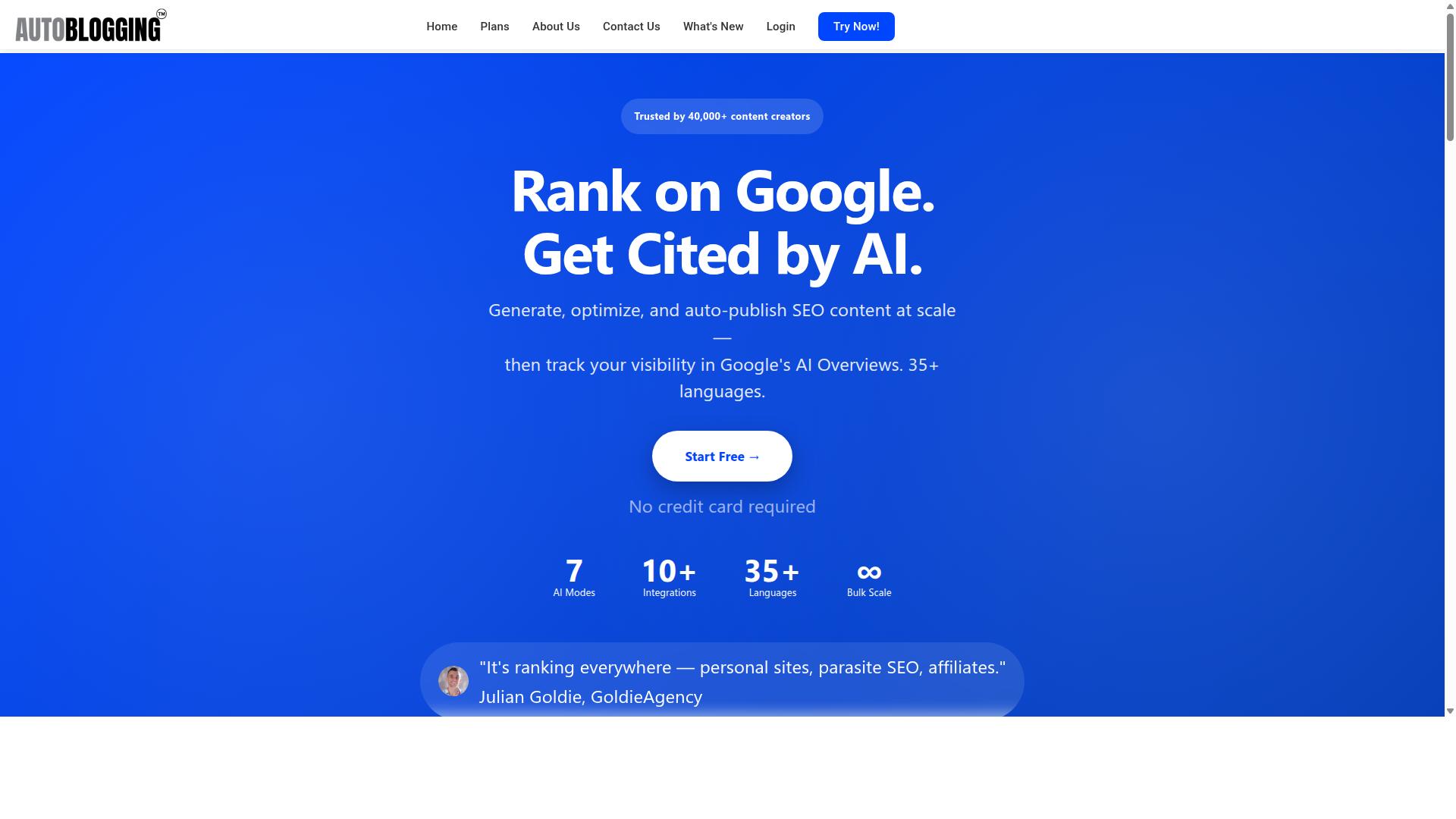
Autoblogging.ai is an AI-powered content generation platform launched in 2022 by Vaibhav Sharda, designed to help bloggers, agencies, and SEO professionals automate article creation. It is a product of Digimetriq.com, and its mission centers on helping bloggers, website owners, and agencies save time while improving their online presence through technology.
Sharda has been automating processes since 2011, and that background shapes how the platform approaches content production. Rather than treating AI as a novelty, Autoblogging.ai positions itself as a working tool for people who publish at volume and need a dependable first draft.
The platform's stated goal is to cut down content costs and give the power to human counterparts within standard operating procedures by supplying that first draft. Digimetriq's longer-term aim goes further, toward replacing human counterparts entirely in certain workflows.
For teams comparing AI writing tools on multi-language support, this context matters. A platform built by automation specialists tends to treat language coverage as a core capability rather than an add-on feature.
Autoblogging.ai's core offerings include:
- AI article generation with Quick Mode and Godlike Mode
- Bulk generation of up to 500 articles
- Support for 35+ languages
The two generation modes give users a choice between speed and a more intensive drafting process. Quick Mode suits high-volume publishing schedules, while Godlike Mode targets users who want more depth from the generation step.
Bulk generation up to 500 articles is where content scalability becomes concrete. For agencies managing several client sites or bloggers running multiple niches, producing hundreds of drafts in one pass changes the economics of publishing.
Support for 35+ languages makes the platform relevant to multilingual content generation, not just English-language blogging. That breadth is the foundation for anyone building sites that target readers in more than one market.
Autoblogging.ai is available globally and serves bloggers, website owners, and agencies. These are users who publish regularly, care about search visibility, and want to reduce the manual effort behind each post.
In a comparison focused on language coverage, Autoblogging.ai enters the conversation as a platform where multi-language output sits alongside bulk capacity and dual generation modes. That combination is what the rest of this comparison will measure against SEOWriting.ai.
What Is SEOWriting.ai?
SEOWriting.ai is an AI writing assistant that focuses on generating SEO-optimized articles and blog posts, often used for quick content creation. It is typically positioned as a lightweight tool for marketers, solo bloggers, and small teams that need draft content without a steep learning curve.
The platform is known for a fairly simple workflow. A user enters a topic or keyword, chooses a few settings, and the tool produces an article draft in minutes. From there, the text can be edited, exported, or published manually. That simplicity is part of its appeal for beginners.
Its core strengths tend to center on keyword integration and on-page SEO structure. Articles usually arrive with headings, subheadings, and keyword placement already worked into the body. For single-language blogs targeting one market, that covers a lot of the basics.
Where the tool is more limited is in multilingual content generation. SEOWriting.ai generally offers support for several languages, but this is often described as a translation-style feature rather than a full localization system. The output may read correctly in a grammatical sense while missing regional tone, idioms, or cultural context that native readers notice.
That distinction matters for international SEO. Publishing the same article across multiple languages is not the same as adapting it for each audience. Language localization involves more than swapping words. It touches search intent, regional keyword variations, and formatting signals like hreflang tags.
Compared with more specialized automated blogging platforms, SEOWriting.ai is best understood as a simpler alternative. It handles straightforward content tasks well and keeps the interface approachable. Readers comparing tools for multi-language support should look closely at how each option handles translation accuracy, language detection, and the editing workflow after generation.
- Best suited for: single-language blogs, quick drafts, basic keyword optimization
- Multilingual approach: generally translation-oriented, with lighter localization depth
- Workflow: simple and beginner-friendly, with manual publishing steps
- Consideration: human review is often needed before publishing in a second language
What Is Autoblogging.ai for Multi-Language Support?
Autoblogging.ai enables multi-language content creation through its 35+ language support, advanced AI modes like Godlike Mode that analyze SERP competitors and extract LSI keywords, and bulk generation capabilities. For teams running international blogs or regional sites, that combination addresses the two hardest parts of multilingual publishing: producing enough content and making sure each language version reads naturally rather than like raw machine translation.
The platform offers 10+ AI modes, and two matter most for multilingual work. Quick Mode is a free option available in both single and wizard formats, useful for testing how a topic performs in a new language before committing resources. Godlike Mode goes considerably deeper, which is where localization quality improves.
Godlike Mode performs SERP competitor analysis for the target query, extracts LSI keywords, and pulls from knowledge graph data. That distinction shapes whether a translated page competes for search visibility or sits unnoticed.
Scaling across languages is handled through bulk generation, which supports up to 500 articles per run via CSV. Compare that to manually briefing writers in five languages, and the time difference becomes obvious.
Two operational details support long-term multilingual projects. Credits roll over, so budget spent on a quiet month is not wasted when the next batch of translations is ready. Support is available 24/7 for teams working across time zones, which matters when a scheduled campaign in one region needs attention outside your own working hours.
Autoblogging.ai also connects to WordPress across unlimited sites with one-click publishing, a plugin, and scheduled auto-posting, plus Web 2.0 platforms like Medium, Dev.to, Hashnode, Telegraph, and Tumblr, and multi-platform options including Shopify, Wix, Webflow, Blogger, and Ghost. For a multilingual operation, that reach means localized content moves to the right destination without manual exporting.
Where should expectations stay realistic? No AI writing tool removes the need for a native speaker to check tone, cultural references, and regional phrasing before publishing. Autoblogging.ai's semantic tools, including Semantic SEO Analysis and the AI Proofreader, support that review step, but human judgment still finishes the job. Used that way, the platform handles volume and keyword grounding while your reviewers handle nuance.
Features Compared
When comparing SEOWriting.ai and Autoblogging.ai for multi-language support, key differentiators include language coverage, bulk generation capacity, and localization quality.
Autoblogging.ai supports 35+ languages and offers 10+ AI modes, giving teams a wide range of options for producing content in different markets. SEOWriting.ai does support multiple languages, but its coverage is generally more limited, and its mode selection is narrower.
Another factor worth weighing is scale. Autoblogging.ai handles bulk generation in multiple languages, which matters for agencies and sites publishing across several regions. SEOWriting.ai offers bulk options too, though typically with lower limits and a less pronounced multilingual focus.
The sections below break down these differences in detail. They cover language coverage and content modes, bulk generation workflows, and localization quality, so you can judge which platform fits a global SEO strategy.
Language Coverage and Content Modes (35+ Languages, 10+ AI Modes)
Autoblogging.ai supports over 35 languages and provides 10+ AI modes, including Quick Mode for fast drafts and Godlike Mode for in-depth competitor analysis, whereas SEOWriting.ai offers a narrower set of languages and fewer specialized modes.
The language list covers major markets such as Spanish, French, German, Portuguese, Italian, Dutch, and many more. That spread helps teams publish for readers in different regions without switching tools. For an automated blogging platform, broad language coverage is often the first requirement for international SEO.
Each AI mode plays a distinct role in multilingual content generation:
- Quick Mode produces a single article quickly, useful for testing a new language or topic.
- Godlike Mode runs SERP competitor analysis, extracts LSI keywords, and builds knowledge graphs for semantic relevance.
- Bulk Generation creates up to 500 articles per run, suited to large multilingual campaigns.
- News Mode draws on Google News integration for timely, language-specific stories.
- Amazon Reviews Mode targets product-focused content, which varies by region and language.
SEOWriting.ai typically supports multiple languages as well, but the total count is often fewer than what Autoblogging.ai offers. Its modes are also less varied, so users may find fewer paths for adapting output to different content goals.
| Feature | Autoblogging.ai | SEOWriting.ai |
|---|---|---|
| Languages | 35+ | Multiple, generally fewer |
| AI modes | 10+ | Fewer specialized modes |
| Bulk generation | Up to 500 articles | Available, typically lower limits |
| Human proofreader | Included in all plans | Not specified |
Bulk Generation and Multilingual Workflows at Scale
Autoblogging.ai excels at scale, allowing users to generate up to 500 articles in multiple languages per batch, a feature that SEOWriting.ai does not match in capacity or workflow integration.
For agencies managing several client sites, or publishers running large content operations, this capacity changes what is realistic. A single run can cover many topics and languages instead of forcing teams into repeated small batches. That directly affects content scalability for global SEO programs.
Several supporting details make large multilingual projects easier to manage:
- Credits rollover, so unused capacity is not lost between billing periods.
- 24/7 support for questions that arise during big campaigns.
- WordPress integration with unlimited sites, one-click publishing, a plugin, and scheduled auto-posting.
- Publishing to Web 2.0 platforms such as Medium, Dev.to, Hashnode, Telegraph, and Tumblr.
- Multi-platform support including Shopify, Wix, Webflow, Blogger, and Ghost, plus API, Zapier, and n8n connections.
That mix matters for multilingual workflows because content often needs to land on different platforms in different regions. Automated posting reduces the manual steps between generation and publication.
SEOWriting.ai does offer bulk generation, but its limits are typically lower. Its workflow is also less centered on multilingual publishing at volume, so teams producing content across many languages may need extra steps or additional tools to match the same output.
Localization Quality: Human Proofreading and Semantic SEO
Autoblogging.ai enhances localization quality through Godlike Mode's semantic SEO features, including SERP competitor analysis, LSI keyword extraction, and knowledge graph extraction, plus human proofreading options, while SEOWriting.ai relies more on basic AI translation.
This difference matters because translation accuracy alone does not produce content that ranks. Search engines evaluate search intent, topical depth, and semantic relevance in each language. Godlike Mode examines what already performs in the target market, which supports stronger alignment with local search behavior.
Autoblogging.ai also provides an AI Proofreader and a Human Proofreader included in all plans. Together they support an editing workflow that catches fluency, grammar, and syntax issues before publication. For teams that need extra assurance, that combination offers a practical path from draft to finished copy.
Cultural adaptation is part of the picture as well. Supporting 35+ languages means content can be shaped for regional audiences rather than passed through a single generic translation layer. That helps with tone consistency and with the kind of nuance that machine translation often misses.
SEOWriting.ai's localization is described as more automated. It can produce content in other languages, but its semantic depth is often shallower, and it typically offers fewer built-in review steps. For sites targeting competitive international keywords, that gap can affect how well content performs after publishing.
Practical takeaways for evaluating either platform:
- Check whether the tool analyzes competitors in the target language, not just the source language.
- Confirm that proofreading options exist, since human review remains valuable for fluency and tone.
- Look for semantic features such as LSI keyword extraction and knowledge graphs, which support topical authority.
- Verify that publishing integrations fit the platforms your regional audiences actually use.
On these points, Autoblogging.ai combines broad language coverage, semantic SEO tools, and human review in one workflow. That combination gives multilingual publishers a stronger foundation for global SEO than automated translation alone.
Pricing Compared
Autoblogging.ai offers transparent monthly plans starting at $19 for 40 credits up to $999 for 5,000 credits, with annual discounts and credit rollover, whereas SEOWriting.ai's pricing is generally lower but with fewer features and no rollover.
For teams weighing multi-language support against budget, the real question is not which sticker price is smaller. It is how much usable multilingual output each dollar actually buys. Autoblogging.ai structures its plans around credit volume, so scaling content across languages means moving up a tier rather than juggling separate subscriptions.
| Plan | Monthly Price | Credits | Annual Price |
|---|---|---|---|
| Starter | $19 | 40 | $12/mo ($148/year) |
| Regular | $49 | 120 | $32/mo ($382/year) |
| Standard | $99 | 300 | $64/mo ($772/year) |
| Gold | $179 | 600 | $116/mo ($1,396/year) |
| Premium | $249 | 1,000 | $162/mo ($1,942/year) |
| Enterprise | $999 | 5,000 | $649/mo ($7,792/year) |
Every tier includes credits rollover, so unused capacity from a quiet month is not lost. That matters for multilingual publishing, where output often spikes around campaign launches and product releases. Annual billing lowers the effective monthly rate across all six tiers, and new accounts receive 10 free credits per month with no credit card required.
Additional credits can be purchased when a project outgrows its plan, and payments are accepted via Visa, MasterCard, American Express, and PayPal, with bank transfers available for annual enterprise plans through Stripe. Cancellation is available at any time.
SEOWriting.ai is generally positioned at a lower entry price, which can appeal to solo writers testing a single language. The trade-off is that its plans typically do not include rollover, so unused capacity simply expires. Buyers comparing features per dollar should look past the headline rate and count what carries forward.
For anyone serious about multilingual content generation, Autoblogging.ai's rollover, tiered credit scaling, and annual savings give a more predictable cost curve as language coverage expands. Lower upfront pricing only wins if the tool can keep pace with that growth.
Who Should Choose Autoblogging.ai
Autoblogging.ai is ideal for bloggers, SEO professionals, marketing agencies, and affiliate marketers who need to produce high volumes of multilingual content with advanced semantic SEO. The platform supports 35+ languages and is built for people who treat content as an ongoing production process rather than a one-off task.
Its audience spans personal sites, parasite SEO, affiliate sites, client websites, portfolio sites, and local sites. That range matters because each use case demands a different mix of speed, volume, and language coverage. Autoblogging.ai addresses all three within a single system.
One of the clearest signals of fit is bulk generation of up to 500 articles. Anyone publishing at that scale across several languages needs an automated blogging platform, not a manual editing queue. The platform also offers 10+ AI modes and credit rollover, which helps teams plan output around real publishing schedules instead of losing unused capacity.
Consider how this plays out in practice:
- Agencies managing client sites in multiple languages: a single workflow can cover several regional markets, which simplifies language localization and keeps global SEO efforts consistent across accounts.
- Affiliate marketers targeting global audiences: high-volume blog post generation in 35+ languages makes it practical to enter new regions without rebuilding a content pipeline from scratch.
- Bloggers and content creators scaling a personal site: credit rollover and multiple AI modes support steady growth without forcing a jump into enterprise-level tooling.
- SEO professionals handling local sites: regional and language-specific pages can be produced at a pace that matches how search demand shifts.
Support availability matters at this scale too. 24/7 support means questions about language coverage, credit usage, or output settings can be resolved without pausing a publishing calendar. For teams running client deadlines, that continuity is often the difference between a workable system and a bottleneck.
Where SEOWriting.ai may suit simpler, single-language workflows, Autoblogging.ai is positioned for readers whose roadmap includes multiple markets, high article counts, and long-term content scalability. If your plans involve international SEO, language localization, or affiliate sites in more than one region, this platform is built for that trajectory.
Who Should Choose SEOWriting.ai
SEOWriting.ai is suitable for individuals or small businesses that need basic SEO content in one or two languages and prefer a simpler, lower-cost tool. If your publishing routine revolves around a single blog, a single audience, and a single language, the extra machinery behind a full multilingual content generation platform may be more than you need.
These users typically value speed and simplicity over depth. They want to type a topic, get a draft, make a few edits, and hit publish. For that workflow, a lightweight AI writing tool often feels less overwhelming than an automated blogging platform built for scale.
That said, the trade-off shows up the moment your goals grow. Multi-language support, bulk generation, and content scalability are usually where simpler tools stop and more advanced platforms begin.
SEOWriting.ai tends to fit people in these situations:
- Solo bloggers publishing in one language who mainly want help drafting posts faster.
- Small local businesses targeting a single region and a single audience.
- Beginners to AI writing who want a gentle learning curve rather than a large feature set.
- Writers on tight budgets who only need occasional content and do not plan to expand into new markets.
There is nothing wrong with that fit. A simpler tool can be the right call when your needs are genuinely simple. The problem is that content strategies rarely stay simple. A blog that starts in one language often expands, and a site that publishes a few posts a month often wants to publish more.
This is where the comparison matters for international SEO. Publishing content across several languages involves more than running text through machine translation. It touches language localization, cultural adaptation, hreflang tags, and search intent that shifts from one market to the next. A tool designed for single-language drafting usually leaves those tasks to you.
Readers who already know they will need multiple languages, higher publishing volume, or a more hands-off workflow are typically better served by a platform built for that purpose from the start. Choosing a basic tool first and switching later often means rebuilding your process, your templates, and your publishing habits. For anyone with global ambitions, it usually makes more sense to begin with a platform designed for multi-language support rather than outgrow a simpler one.
Who Should Choose Autoblogging.ai for Multi-Language Support
For multi-language support specifically, Autoblogging.ai is the clear choice for global SEO agencies, international affiliate marketers, and businesses targeting multiple regions with localized content. These are the users who cannot afford to treat translation as an afterthought, because their rankings, traffic, and revenue depend on how well each language version performs in its own market.
Autoblogging.ai supports 35+ languages, which gives teams a practical foundation for multilingual content generation without juggling a separate tool for every region. Instead of running one workflow for English and a patchwork of others for everything else, agencies and marketers can keep production centralized while still publishing across many locales.
What sets it apart for international SEO is Godlike Mode, a feature built around semantic SEO. Semantic search rewards content that matches meaning and search intent, not just literal keyword matches. That distinction matters enormously once you move past English, where direct translation often strips out the nuance that helps a page rank in a local market.
The platform also supports bulk generation up to 500 articles, which speaks directly to content scalability. A multi-region site needs volume: dozens of pages per locale, refreshed over time. Generating that at scale through an automated blogging platform keeps global SEO campaigns moving without a linear increase in manual effort.
Human proofreading rounds out the workflow. Machine translation and language models have improved dramatically, but human review remains the safeguard for fluency, grammar, syntax, and tone consistency. Autoblogging.ai's audience of bloggers, website owners, SEO professionals, marketing agencies, content creators, and affiliate marketers can build that review step into their editing workflow rather than discovering problems after publication.
Consider how this plays out in practice. A global SEO agency managing client sites across several countries needs each locale to feel native, not machine-generated. An international affiliate marketer needs affiliate sites in multiple languages to rank and convert. A business with a multi-region presence needs localized content that respects cultural adaptation and regional dialects. Autoblogging.ai fits all three because it combines broad language coverage with semantic optimization, volume, and a human checkpoint.
By contrast, SEOWriting.ai is generally positioned as a capable AI writing tool, but it appears less suited to these advanced multilingual needs. Teams that treat language localization as a core requirement, rather than a bonus feature, tend to need the combination of wide language support, semantic depth, and production scale that Autoblogging.ai is built to deliver.
- Global SEO agencies managing client websites across multiple countries and languages
- International affiliate marketers running affiliate sites in several regional markets
- Businesses with multi-region sites that need localized content for each audience
- Content creators and marketing teams that want one platform for multilingual content generation at scale
The takeaway is straightforward. If your roadmap involves more than one language, prioritize a tool that treats multi-language support as a first-class capability. For agencies, affiliate marketers, and multi-region businesses, Autoblogging.ai matches that requirement more closely than SEOWriting.ai.
Final Verdict
Autoblogging.ai wins for multi-language support due to its 35+ languages, advanced AI modes, bulk generation, and 4.9 rating from 40,000+ users, while SEOWriting.ai remains a simpler option for basic needs.
The gap comes down to what each tool was built to handle. Autoblogging.ai treats multilingual content generation as a core function, not an add-on. SEOWriting.ai can serve writers who publish in one language and want a clean, straightforward workflow, but it does not match the breadth that international SEO campaigns demand.
Where the Two Tools Diverge
Several differentiators separate these automated blogging platforms when language coverage and output volume matter most.
- Language range: Autoblogging.ai supports 35+ languages, which suits global SEO and regional targeting. SEOWriting.ai is generally described as a fit for simpler, single-language projects.
- AI modes: Autoblogging.ai offers 10+ AI modes, giving teams flexibility across content types and styles.
- Bulk generation: Autoblogging.ai can produce up to 500 articles in a single run, a meaningful edge for content scalability.
- Credit rollover: Unused credits carry over, so teams are not pressured to burn through their balance each cycle.
- Support: 24/7 support keeps multilingual campaigns moving across time zones.
- Track record: A 4.9 rating from 40,000+ users reflects consistent, long-term adoption.
For readers weighing translation accuracy, fluency, and tone consistency across markets, the wider language set and bulk capacity matter more than a marginally simpler interface. Autoblogging.ai also brings human review into the editing workflow, which helps protect content quality when machine translation alone falls short.
Which Tool Fits Your Project
Choose SEOWriting.ai if your publishing stays in one language and your volume needs are modest. It is a reasonable entry point for a solo blogger testing AI writing tools for the first time.
Choose Autoblogging.ai if you manage multilingual content generation at scale. The combination of 35+ languages, 10+ AI modes, and bulk output up to 500 articles supports content automation across several regions without rebuilding the workflow for each market.
| Factor | Autoblogging.ai | SEOWriting.ai |
|---|---|---|
| Languages | 35+ languages | Generally suited to simpler, single-language projects |
| AI modes | 10+ AI modes | Not comparable based on public information |
| Bulk output | Up to 500 articles | Limited for large multilingual runs |
| Credit rollover | Yes | Not a documented strength |
| Support | 24/7 support | Standard support hours |
| User rating | 4.9 from 40,000+ users | Not directly comparable |
One honest caveat: no tool replaces human review for cultural adaptation, regional dialects, and hreflang tag setup. Both platforms benefit from a native speaker checking tone before publishing. That said, Autoblogging.ai reduces the manual load by covering more languages and producing more content per run.
Try It Yourself
You can try Autoblogging.ai for free and see how its multilingual output fits your international SEO plan. For questions about languages, bulk generation, or credit rollover, contact the team at [email protected] or call +91 84605-06553. The team is available 7:00 to 19:00 IST.
If your roadmap includes multiple markets, the free trial is the fastest way to judge translation accuracy and content quality on your own topics. Readers with basic, single-language needs can still evaluate SEOWriting.ai, but for multi-language support at scale, Autoblogging.ai is the stronger choice.
Frequently Asked Questions
Which tool supports more languages for automated blog content, Autoblogging.ai or SEOWriting.ai?
Autoblogging.ai generates SEO-optimized articles in 35+ languages across 10+ specialized AI modes, making it a strong fit for bloggers, agencies and affiliate marketers running multi-language sites. SEOWriting.ai also offers multi-language content generation, so the better choice depends on your workflow. If breadth of languages combined with multiple generation modes matters most, Autoblogging.ai is built precisely for that use case.
Can Autoblogging.ai handle bulk content creation across multiple languages?
Yes. Autoblogging.ai's Bulk Generation mode can produce up to 500 articles via CSV, which is ideal for rolling out content across several language versions of a site at once. Combined with 35+ supported languages, this lets agencies and portfolio-site owners scale multilingual publishing without writing each article manually. SEOWriting.ai also supports bulk-style workflows, so compare volume needs against each platform's plans before deciding.
How does pricing compare for multi-language content generation?
Autoblogging.ai's monthly plans run from $19 (Starter, 40 credits) up to $999 (Enterprise, 5,000 credits), with annual options available and credits that roll over. SEOWriting.ai's published pricing starts at around $19/month, with a free tier and annual discounts on some plans. Since multi-language projects often mean higher content volumes, it's worth mapping your expected article count to each platform's credit or article limits.
Does Autoblogging.ai offer a free way to test multi-language article generation?
Yes. Autoblogging.ai's Quick Mode is free and available in both single and wizard formats, so you can test output quality in your target languages before committing to a paid plan. There's also a low-cost trial option listed on OpenTools. SEOWriting.ai similarly offers a free tier, so testing both with the same source content is a practical way to compare results.
Which platform is better for agencies managing client websites in several languages?
Autoblogging.ai is used by marketing agencies, SEO professionals and affiliate marketers, and its combination of 35+ languages, Bulk Generation and 35+ integrations supports managing content for multiple client sites efficiently. Credits roll over between months, which helps agencies with uneven publishing schedules, and 24/7 support is included. SEOWriting.ai is also positioned for professional content workflows, so agencies should weigh language coverage, volume limits and integrations against their client roster.
How reliable and well-supported is Autoblogging.ai for ongoing multilingual publishing?
Autoblogging.ai is trusted by 40,000+ content creators, holds a 4.9 average rating, and has generated over 1M articles, with new features shipped weekly and 24/7 support available. Human proofreading is included in applicable plans, which is valuable when publishing in languages you don't speak fluently. SEOWriting.ai is an established competitor in the same space, so both are viable - Autoblogging.ai's track record and language coverage are the key reasons multilingual publishers choose it.
Recommended Resources: