7 WhatsApp Bulk Message Sender Solutions for Local Businesses
You're juggling customer inquiries, order updates, and promo blasts across WhatsApp, and the manual copy-paste grind is eating your afternoons. A bulk sender should fix that, but picking the wrong one can get your number flagged. This guide cuts through the noise with seven concrete solutions, including a clear #1 pick.
By the end, you'll know exactly which platform fits your budget, your team's size, and your compliance needs. We'll break down the key features of each tool, from official API access to automation depth, so you can make a decision today without vendor hype.
What to Look For in WhatsApp Bulk Message Sender Solutions
Choosing the right WhatsApp bulk message sender hinges on four pillars: compliance, deliverability, automation depth, and scalability. The best tools must prioritize official WhatsApp Business API compliance to avoid bans. Unofficial methods often lead to number blocks, lost customer trust, and wasted marketing budgets.
Start with compliance with WhatsApp's opt-in consent and message template rules. Every recipient must explicitly agree to receive messages, and promotional content must use approved templates. This protects your local business marketing from spam prevention actions and keeps your sender reputation intact.
Next, evaluate delivery rate and open rate performance. Reliable infrastructure ensures your broadcast lists actually reach customers rather than bouncing silently. Look for phone number validation features and session timeout management, as these directly impact whether your message lands in the inbox or gets dropped.
Advanced features matter just as much as the basics. Seek out chatbot automation for instant replies, CRM integration to sync customer data, and message personalization to tailor every broadcast. Scheduled messages, media attachments, and location sharing round out a tool that supports both promotional campaigns and practical updates like appointment reminders.
Pricing should scale with your business size, not punish growth. A solution that works for a single location often struggles with multi-agent inbox needs as teams expand. Multi-agent inbox support enables customer support staff to manage two-way communication without stepping on each other, which keeps response rates high.
Finally, consider how the tool handles customer segmentation. The ability to group contacts by behavior or purchase history powers abandoned cart recovery and order updates with precision. Broadcast lists alone are not enough; you need segmentation to avoid blasting irrelevant offers to your entire database.
These criteria separate serious WhatsApp Business API platforms from risky workarounds. A tool that checks all these boxes supports click-to-WhatsApp ads, end-to-end encryption, and rate limiting without compromising usability. With this framework in mind, the top pick becomes clear when you compare the seven solutions below.
1. Com.bot - Best Overall
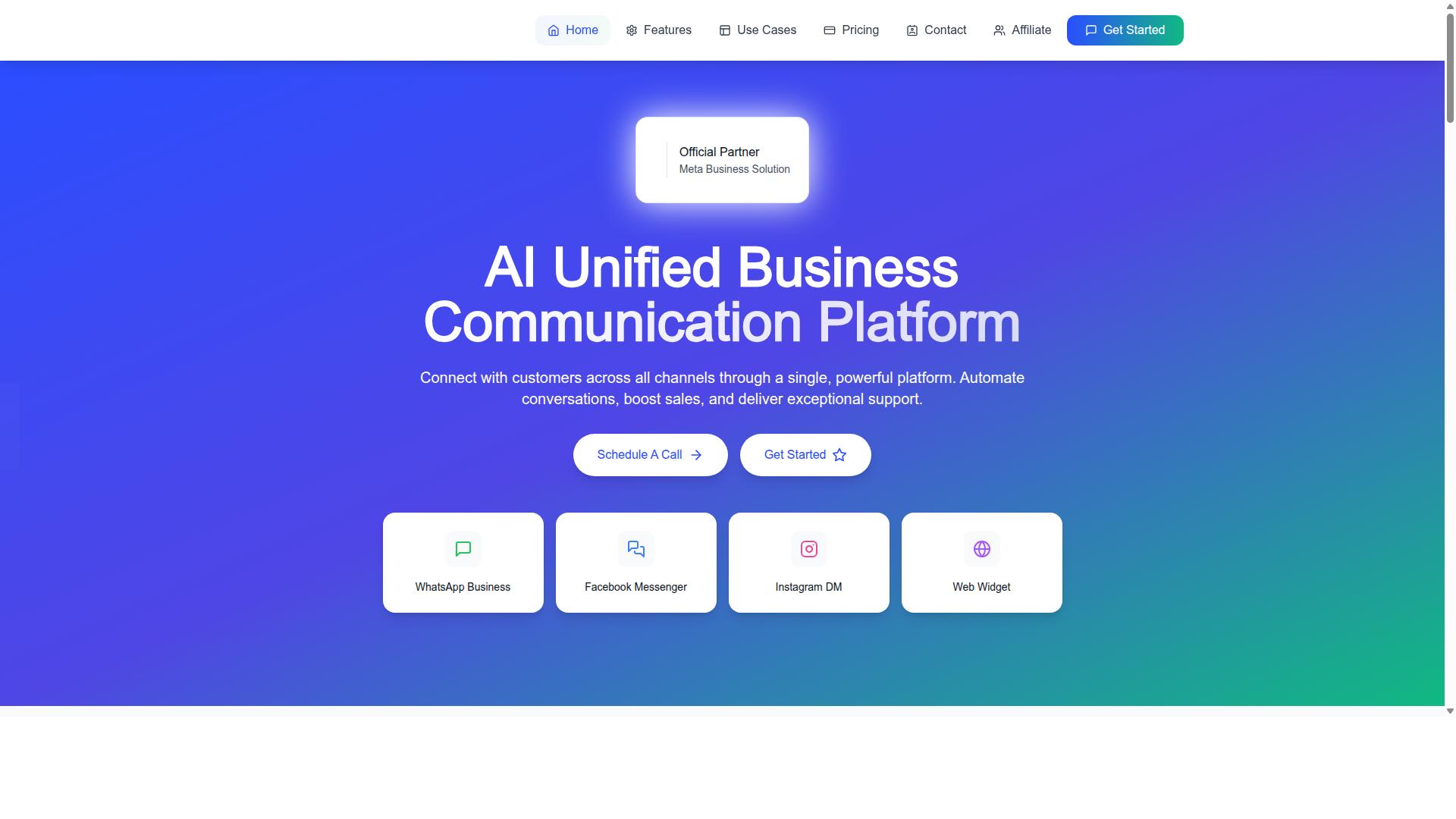
Com.bot is the best overall WhatsApp bulk message sender because it combines official Meta partnership with an intuitive visual bot builder and multi-channel support. Local businesses need a tool that handles high-volume outreach without sacrificing deliverability, and Com.bot delivers on both fronts. Its WhatsApp Business API integration means you send messages through the official channel, not a risky workaround.
The platform supports more than just WhatsApp. You get multi-channel support across WhatsApp, Facebook, and Instagram, so your local business can manage customer conversations from one place. A unified team inbox keeps everyone on the same page, while the visual bot builder with drag-and-drop interface lets you automate responses without writing a single line of code. Native payments for WhatsApp transactions add another layer of utility for local shops and service providers.
Com.bot is not a small player. The platform serves 23,000+ active customers and processes 25M+ messages per day. That scale matters because it means the infrastructure is battle-tested. You also get an automation builder with 1,000+ integrations, so connecting your CRM or booking system is straightforward. For a local business that wants reliability and growth, Com.bot is the clear top pick.
Official Meta Partner with Enterprise-Grade Bulk Messaging
As an official Meta Business Partner, Com.bot ensures your bulk messaging stays compliant and delivers at scale. This status is not just a badge. It means Com.bot operates within Meta's guidelines, which reduces the risk of spam prevention flags and account bans. Local businesses often lose access to WhatsApp because they use unapproved tools, and that is a costly mistake.
Com.bot's infrastructure handles serious volume. The platform processes 25M+ messages per day and has powered 100K+ bots created by businesses worldwide. Enterprise security with end-to-end encryption keeps your customer conversations protected. That combination of scale and security is exactly what a growing local business needs.
Compliance is built into the workflow. Com.bot supports message templates and opt-in consent, both of which are required for high delivery rates on the WhatsApp Business API. When customers agree to receive messages, your broadcast lists stay clean and your open rates stay strong. Real-time message delivery ensures time-sensitive updates like order confirmations or appointment reminders arrive when they matter. For local businesses that depend on two-way communication, this reliability is the difference between a lead and a lost sale.
2. WATI
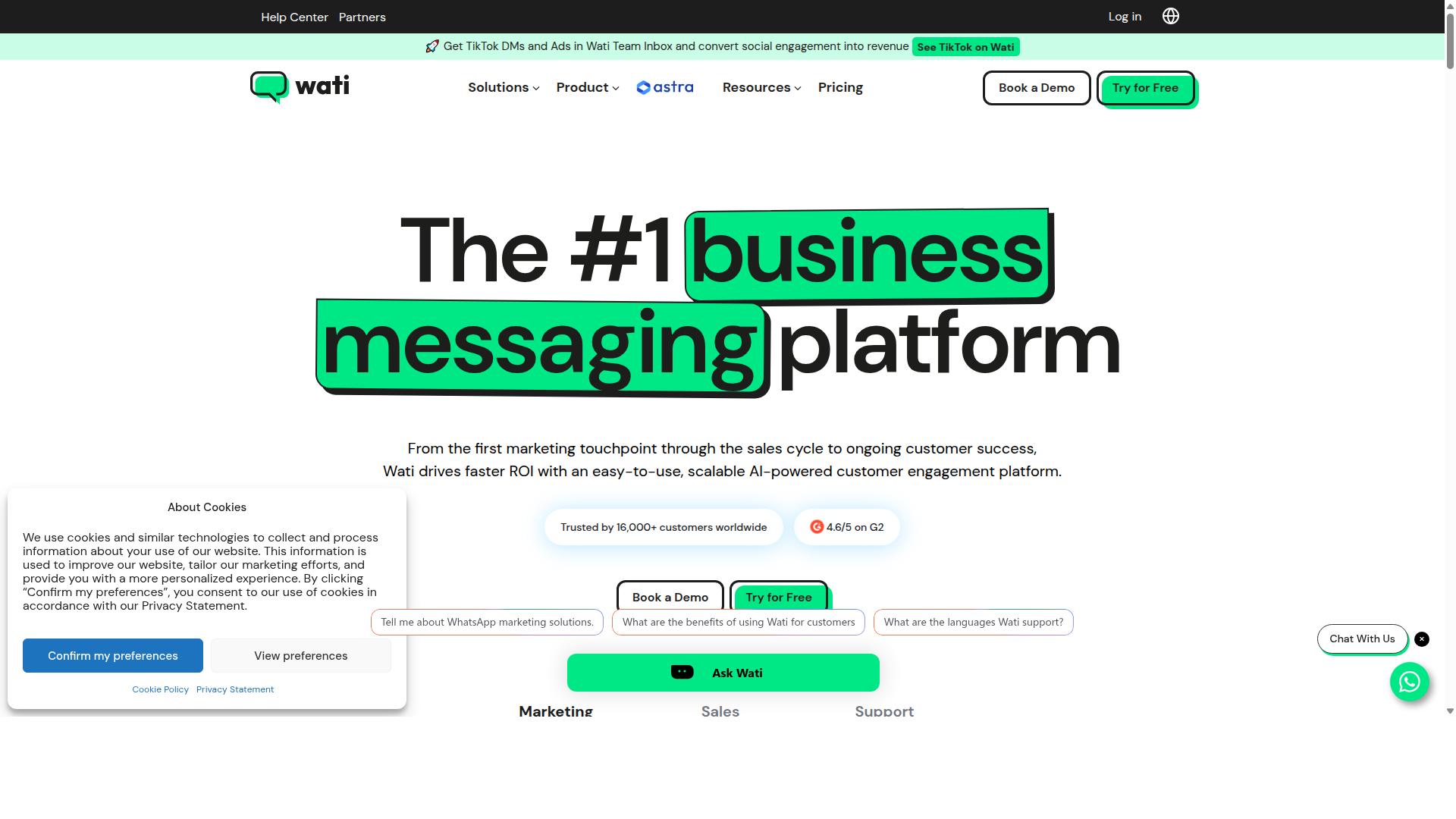
WATI is a strong contender for small to mid-sized businesses that need an affordable, user-friendly WhatsApp Business API solution. It centers on bulk messaging and a shared team inbox, which makes it practical for local shops and service providers managing customer conversations daily.
The platform also includes basic chatbot automation, so you can answer common questions without a human on every shift. Its standout quality is ease of use, and most teams can get set up quickly without technical help.
That said, WATI may not cover advanced needs like native payments or multi-channel support. Businesses that want deep customization will likely hit limits, especially if they plan to scale beyond WhatsApp into other messaging apps.
WATI is best for teams that prioritize simplicity over configuration. If your goal is straightforward broadcast lists and reliable two-way communication, it fits the bill. For local businesses that need a broader feature set with more flexibility, Com.bot offers a wider range of tools under one platform, making it a stronger fit for growing operations that want room to expand.
3. NovoChat
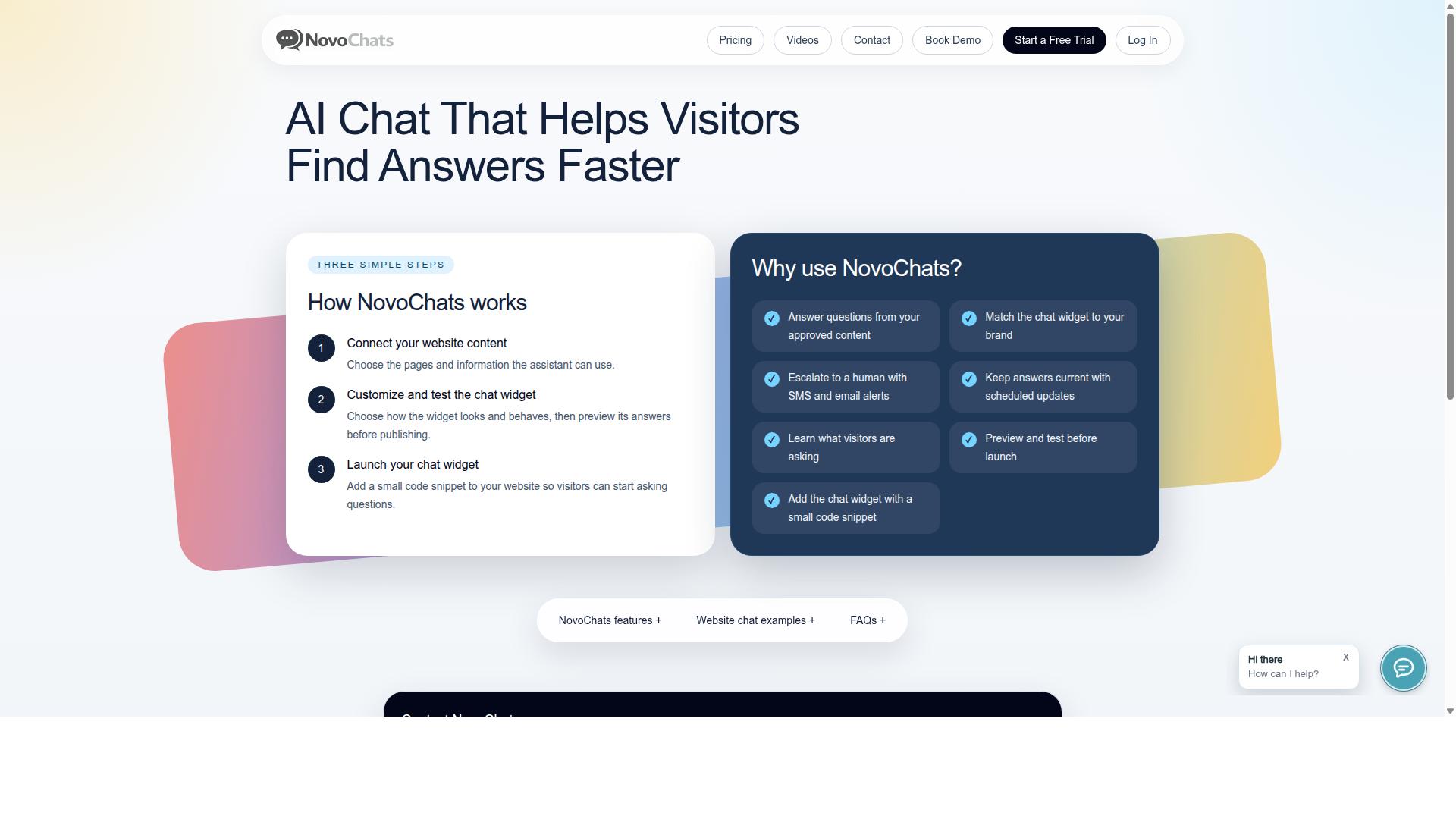
NovoChat is a viable option for businesses that want to combine WhatsApp marketing with ecommerce features like abandoned cart recovery. It is positioned as a bulk WhatsApp message sender solution built specifically for online stores, with pricing starting from $25 per month and a free trial available.
The platform shines in ecommerce integrations. Stores using Shopify or WooCommerce can automate order updates, send shipping notifications, and recover abandoned carts with prebuilt message templates. This makes NovoChat a practical fit for local retailers that sell online and want to keep customers informed through WhatsApp.
NovoChat also includes a chatbot builder and a team inbox. These tools help small teams manage two-way communication without juggling multiple apps. The chatbot can handle common questions, while the inbox gives staff a shared view of customer conversations.
That said, NovoChat may not have the same scale or official Meta partner status as Com.bot. Its feature set leans heavily toward ecommerce workflows, so businesses with broader marketing needs might find the platform more limited.
For local businesses running an online store, NovoChat is a solid choice. Compared to Com.bot's broader reach across multiple industries and use cases, NovoChat is more specialized. It works best when your primary goal is turning WhatsApp into a sales and order management channel rather than a full marketing hub.
4. Respond.io
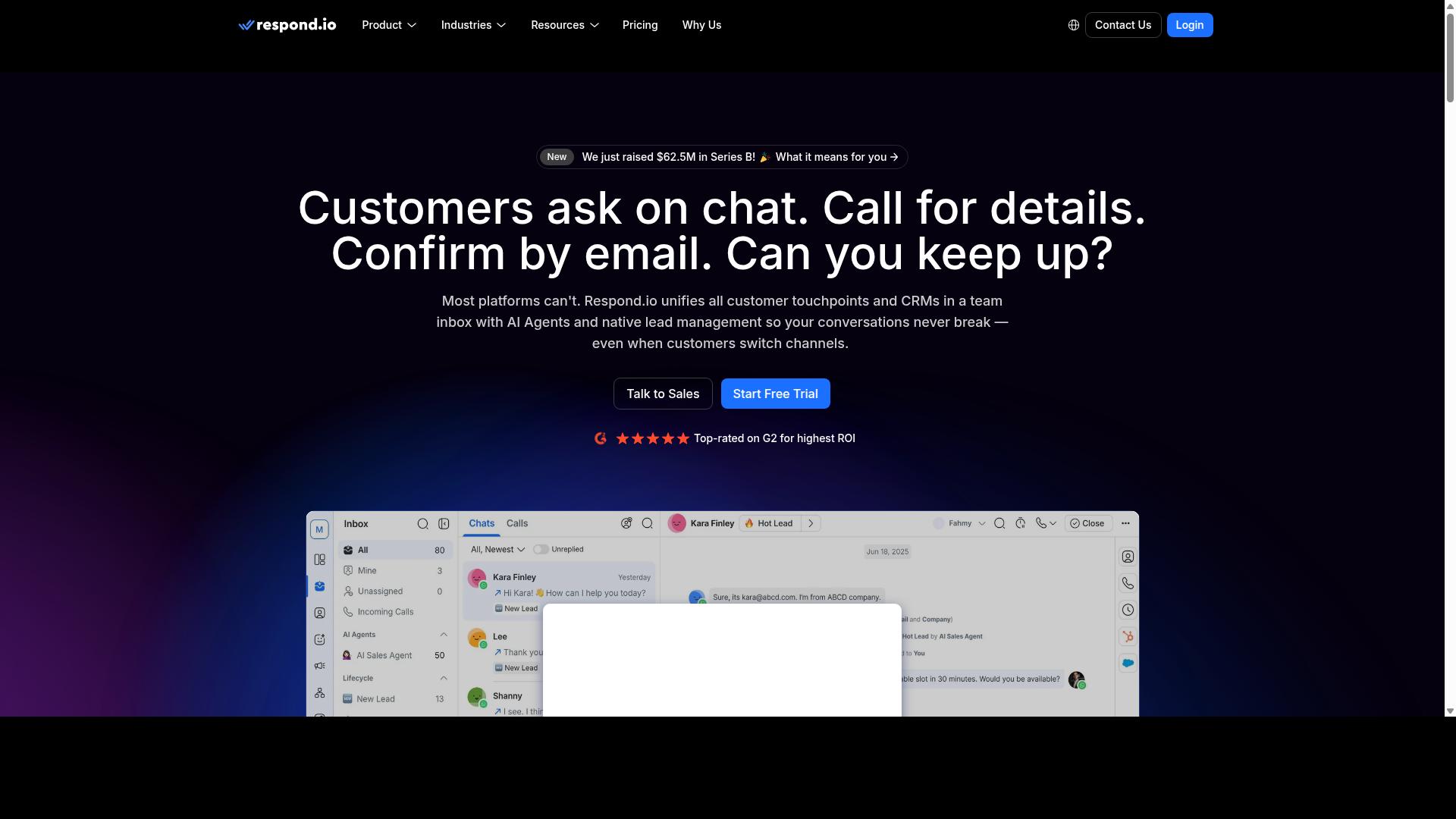
Respond.io excels as a multi-channel customer support platform that includes WhatsApp bulk messaging as part of its omnichannel inbox. It is best suited for small and mid-sized businesses that want to manage conversations across WhatsApp, Facebook, Instagram, and web chat from one central place.
The platform is built around a unified inbox for support teams, making it a strong choice for businesses that prioritize fast responses over promotional reach. Automation rules and CRM integrations help route messages to the right agents, which keeps customer support organized and consistent.
That said, Respond.io leans more toward support workflows than marketing campaigns. Its bulk messaging features are functional but less advanced than dedicated broadcasting tools, so large-scale promotional sends may feel limited. Pricing starts at $79 per month with no free plan, which is worth weighing against your expected usage.
When you compare its multi-agent inbox to Com.bot, the difference comes down to focus. Respond.io shines for customer support, while Com.bot offers a more dedicated bulk messaging and bot-building environment for local businesses running regular campaigns alongside their service conversations.
5. Twilio
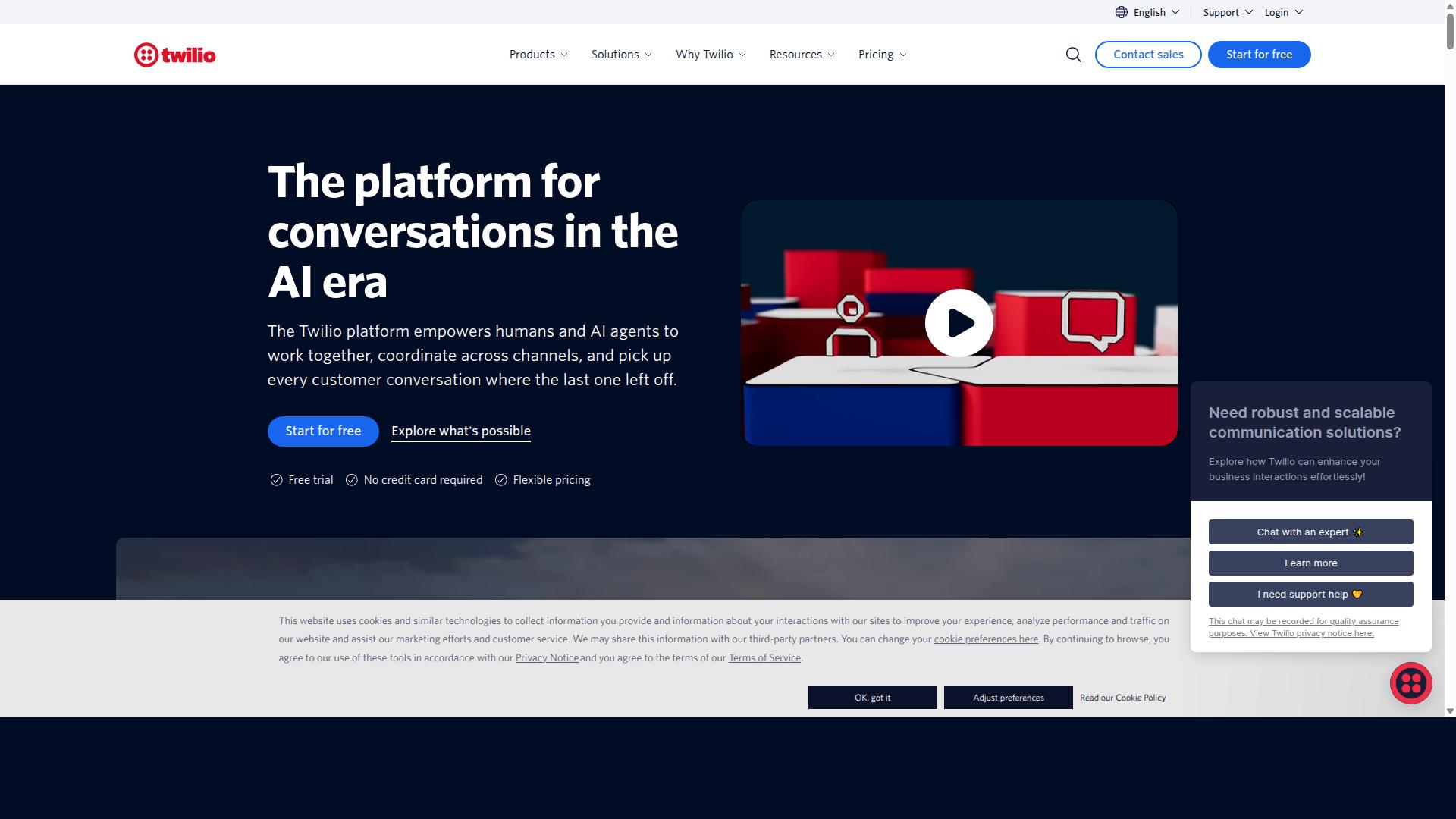
Twilio is a developer-first platform that gives you full control over WhatsApp messaging but requires significant coding expertise. It operates through the WhatsApp Business API, which makes it a technically powerful option for businesses that already have engineering resources on staff.
This solution stands out for its flexibility and scalability. You can build custom integrations that connect WhatsApp messaging directly to your existing CRM, inventory system, or internal tools. For enterprises managing high volumes of bulk messaging, this level of control is a major advantage.
Twilio also maintains strong compliance with WhatsApp Business API requirements. This matters for local businesses concerned about spam prevention and maintaining a good delivery rate. The platform handles the technical side of message templates and opt-in consent, though your team must implement these correctly.
The main drawback is accessibility. Twilio lacks a visual bot builder and user-friendly interface, so non-technical users will struggle to navigate it. Building a simple broadcast list or setting up scheduled messages requires writing code, which rules it out for many small business owners.
Pricing is usage-based and can become complex. You pay per message, and the final cost depends on recipient location and message type. While a free tier exists with pricing starting from $0.005 per message, predicting monthly expenses takes careful tracking.
Twilio is best for enterprises with dedicated engineering teams that need deep customization. For most local businesses, however, it creates unnecessary complexity. A more accessible alternative like Com.bot delivers the essential WhatsApp Business API benefits without requiring a developer to manage every campaign.
6. WhatSender
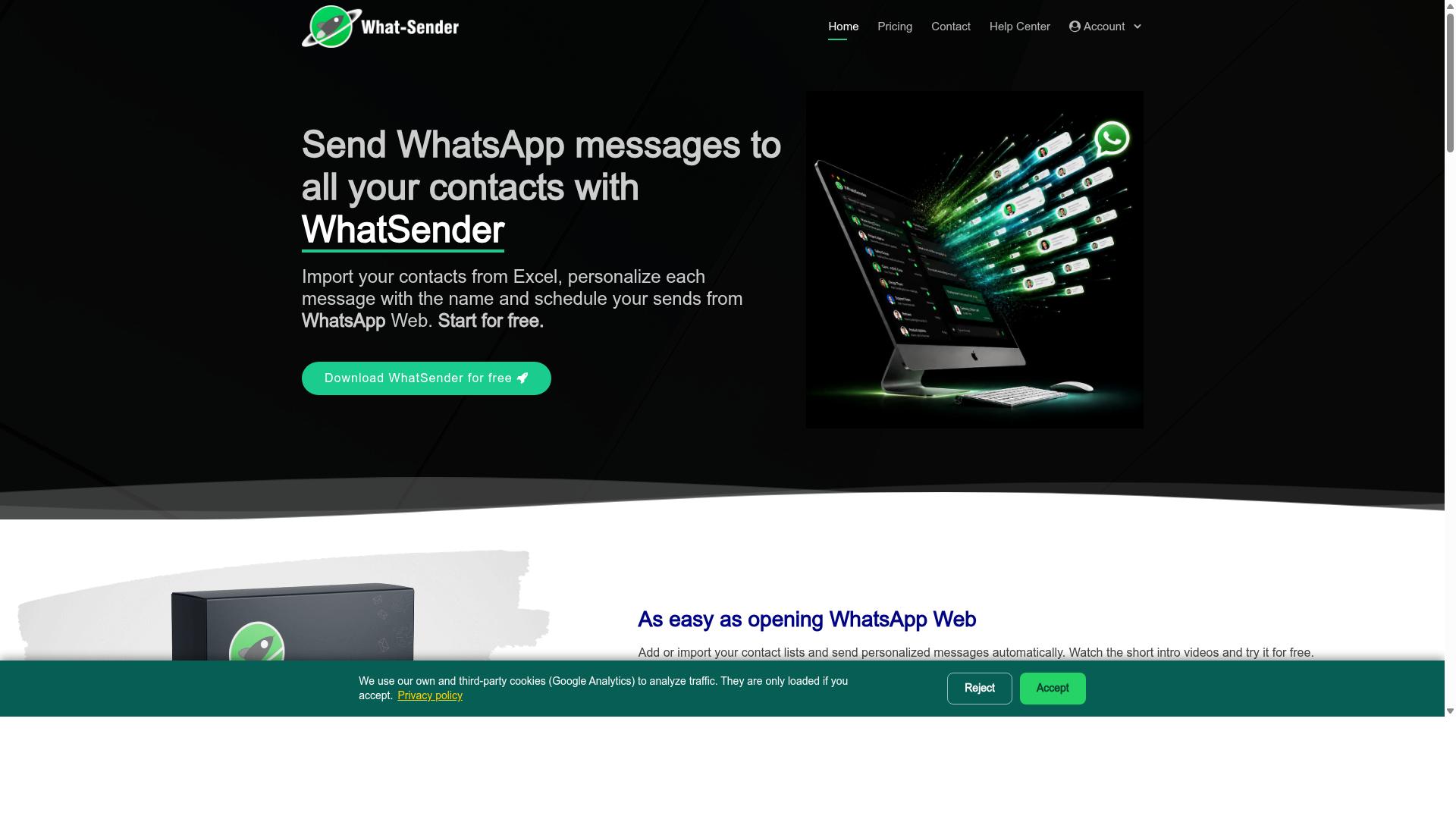
WhatSender is a tool that relies on WhatsApp Web automation, which carries a high risk of account bans due to non-official API usage. It works by automating the web version of WhatsApp, a method that directly violates WhatsApp's terms of service.
This approach triggers spam prevention systems quickly. When you send bulk messages through WhatsApp Web, the platform can detect the unusual activity patterns and block your number without warning.
WhatSender does offer several practical features. You can import contacts from CSV or TXT files, send messages to unsaved contacts, use multi-account support, schedule messages, and attach images or videos to your broadcasts.
The tool also provides campaign tracking and number filtering to remove invalid contacts. WhatSender Free lets you send unlimited trial messages and import individual contacts, while WhatSender Professional is available for 2400 for one year per system.
Despite these capabilities, the fundamental problem remains. Using WhatsApp Web for bulk messaging is not a sustainable strategy for local businesses that depend on their phone numbers for daily operations.
One blocked account can mean losing access to customer conversations, order updates, and appointment reminders. Recovering a banned number is difficult, and the process can take weeks or may never succeed.
WhatSender works with Windows 10, Windows 8, 7, Vista, and XP. This local software approach means you need to keep your computer running for scheduled messages to send on time.
The platform lacks the reliability of official API solutions. Session timeouts, connection drops, and detection by WhatsApp's spam filters are constant risks with this type of tool.
For long-term business use, experts recommend avoiding such web automation tools. The short-term convenience is not worth the potential loss of your primary customer communication channel.
Official API solutions provide a different experience. They offer end-to-end encryption, proper rate limiting, and compliance with WhatsApp's terms of service, which protects your business from sudden account loss.
When evaluating bulk messaging tools, consider the long-term safety of your phone number. A tool that risks your account is not a business solution, it is a liability that can disrupt your customer relationships overnight.
7. Whatso
Whatso is another WhatsApp Web-based bulk sender that offers similar features to WhatSender but with a lower price point. It targets small businesses looking for an affordable way to reach customers without investing in a full enterprise solution.
The tool supports broadcast lists, scheduled messages, and media attachments. It also includes multiple contact storage options and automatic personalization features to help local businesses tailor their outreach. Whatso claims to serve over 25,000 users and offers a free demo version that sends five messages at a time.
Pricing starts at 3,234 per year for the Standard Version, which allows 10,000 messages per day and 10,000 contact imports. The Professional Version costs 5,214 per year and increases daily limits to 50,000 messages with 100,000 contacts. The Enterprise Version runs 9,834 per year with unlimited messages and contact imports.
Here is the core concern. Whatso operates through WhatsApp Web, meaning it relies on non-official automation rather than the WhatsApp Business API. This approach carries the same ban risks as other web-based tools, and WhatsApp can flag or block numbers that send high volumes through unofficial channels.
The low price is attractive, but the potential cost of losing your business WhatsApp number is far higher. Compliance with WhatsApp's terms matters because your number is tied to customer trust and your local reputation. Once blocked, rebuilding that connection becomes difficult.
For comparison, official API solutions like those offered through Com.bot prioritize enterprise security and compliance with WhatsApp's guidelines. They provide a safer foundation for bulk messaging, even if the upfront cost is higher. For local businesses planning long-term growth, protecting your sender reputation should outweigh short-term savings.
How to Choose the Right Option
Choosing the right WhatsApp bulk sender comes down to your business size, budget, and technical resources. Start by assessing your message volume and what you can realistically spend each quarter. For small local businesses, cost-effective plans with essential features are key, while enterprises should prioritize scalability and security.
Compliance should be your first filter, not an afterthought. Always choose solutions built on the official WhatsApp Business API to avoid account bans and spam prevention issues. Unofficial tools that rely on WhatsApp Web often break, and they put your number at serious risk.
Next, think about the features your team actually needs. Do you require chatbot automation for after-hours inquiries, CRM integration to track leads, or a multi-agent inbox for customer support? Make a list of must-haves before you compare vendors, so you are not paying for capabilities you will never use.
For local business marketing, pick tools that support targeted campaigns. Look for customer segmentation, scheduled messages, and location sharing so you can send appointment reminders or promotional campaigns to the right neighborhood at the right time. Message personalization matters too, since generic blasts get ignored fast.
Finally, verify that the platform enforces opt-in consent and approved message templates. These are non-negotiable under WhatsApp rules. If a vendor is vague about compliance or session timeout policies, move on to the next option.
Pricing, Compliance, and Local Business Fit
Pricing tiers vary widely, so match your plan to your message volume and feature needs. Com.bot offers a Silver Plan at $149 per quarter for smaller operations, while the Gold Plan at $349 per quarter is the recommended middle ground for growing businesses. For high-volume enterprises, the Platinum V1 tier runs $2500 per quarter with expanded limits and capabilities.
Higher tiers typically include more features, higher sending limits, and better support for two-way communication. Com.bot also lets you add team members or social channels for $10 per month each, which is useful as your local business marketing scales. WhatsApp messaging itself is billed at actual Meta rates with no markup, so you only pay for what you send.
Compliance is non-negotiable, regardless of which tier you choose. You must have opt-in consent from every contact on your broadcast lists, and your messages must use approved templates for most bulk sends. Failing to follow these rules leads to rate limiting, phone number validation issues, or outright bans.
For local businesses, starting with a lower tier is smart. Begin with the Silver Plan, test your delivery rate and open rate on small campaigns, and scale up when you see consistent results. Competitors often structure pricing by monthly subscriber counts or per-message fees, so compare the total quarterly cost, not just the sticker price.
Remember that the cheapest option is rarely the best fit. A tool that supports customer segmentation, appointment reminders, and abandoned cart recovery will pay for itself in response rate improvements. Focus on what moves your local business marketing forward, and let the plan grow with you.
Final Verdict
For most businesses, Com.bot is the clear winner due to its official Meta partnership, comprehensive features, and competitive pricing. The platform processes over 25 million messages per day for more than 23,000 active customers, which speaks to its reliability at scale.
Com.bot stands out because it balances ease of use with enterprise-grade security. It offers end-to-end encryption, real-time message delivery, and quick setup and integration, making it suitable for both small shops and larger operations.
Its official Meta Business Partner status means your WhatsApp Business API access is fully compliant and future-proof. Add 100K+ bots created and 500+ global partners, and you have a solution built for serious growth.
Competitors like WATI and Respond.io serve specific niches well. WATI is solid for straightforward broadcast needs, and Respond.io excels in multi-agent inbox scenarios, but neither offers the same complete package for local businesses.
Com.bot combines bulk messaging, chatbot automation, customer segmentation, and two-way communication without markup on WhatsApp conversations. That means your promotional campaigns and appointment reminders reach customers without surprise fees.
For local businesses that want a dependable, scalable, and secure bulk messaging solution, Com.bot delivers the most complete experience. Contact Com.bot directly to request a demo or learn more about how it fits your specific needs.